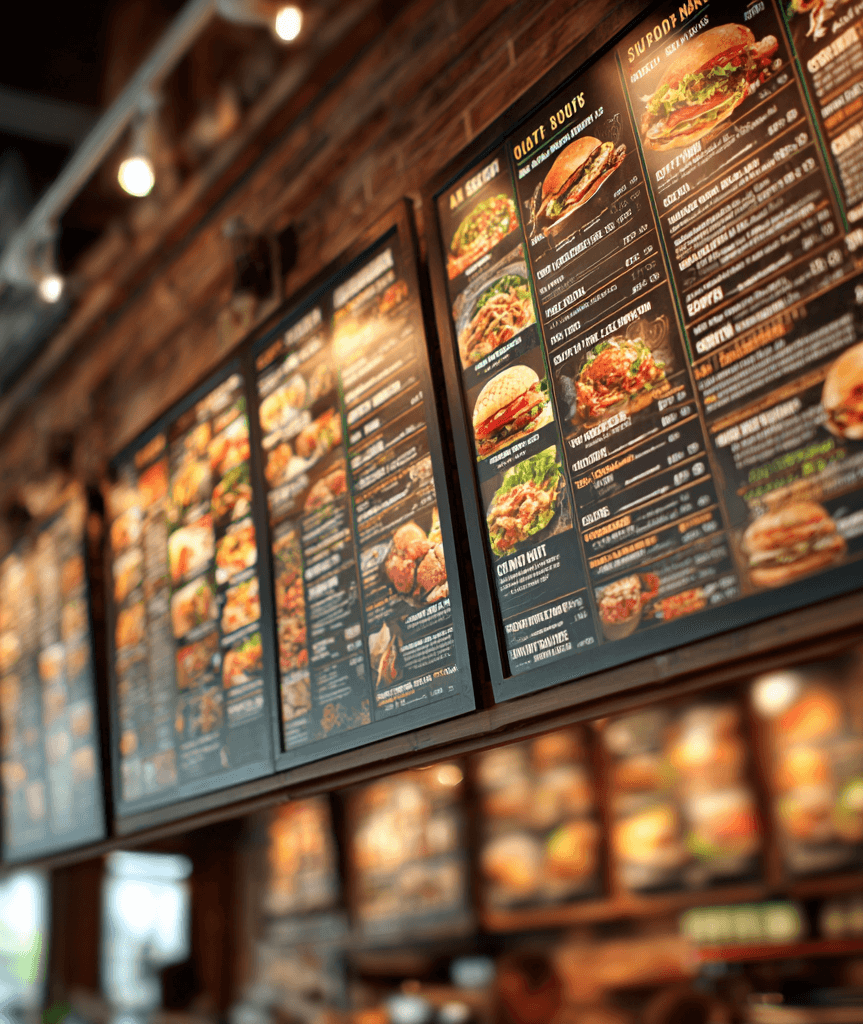
What a large menu actually costs
Every menu item requires its own set of ingredients. Those ingredients need to be ordered, stored, prepped, and managed for spoilage. A menu with 60 items may require stocking 200 to 300 distinct ingredients. Compare that to a tightly designed 25-item menu that might use 80 to 100 ingredients with significant cross-utilization between dishes.
The operational drag of a large menu is enormous: more SKUs to order, more items to count in inventory, more spoilage risk on low-velocity ingredients, more complexity in training new staff, more error rates during service, and a longer time-to-table as customers navigate more options.
The psychology of too much choice
Behavioral economists call it choice paralysis: when presented with too many options, decision-making becomes harder and satisfaction with the eventual choice decreases. In a restaurant context, large menus slow table turn (customers take longer to order), increase decision anxiety, and reduce confidence in the kitchen's ability to execute everything well.
The implicit message of a very large menu is that the kitchen is trying to be everything to everyone. The implicit message of a tight, confident menu is that the kitchen knows exactly what it does well. Customers respond to that confidence — and spend more when they trust the concept.
McDonald's operates on a simplified menu by design. Their most profitable period in recent memory followed a menu reduction, not an expansion. The math is the same at every scale.
The spoilage and waste multiplication effect
Every unique ingredient on a menu that appears in only one or two dishes is a spoilage risk. If a specialty item sells 10 portions a week and you need to order a minimum of 2kg from your supplier, you will consistently have more than you need. That surplus spoils. You've effectively embedded a hidden food cost into every plate of that dish — the cost of the spoilage per unit sold.
Cross-utilization — designing your menu so that ingredients appear in multiple dishes — is one of the highest-ROI activities in menu development. A caramelized onion preparation that goes into three dishes justifies its prep time and spoilage risk far better than one that goes into a single dish.
How to right-size your menu
- Audit every item by three criteria: contribution margin, sales volume, and ingredient overlap with other dishes.
- Remove items that score low on all three — low margin, low sales, unique ingredients.
- Consolidate dishes that share most ingredients. A menu of 25 well-composed dishes with high cross-utilization almost always outperforms a menu of 60 poorly composed ones.
- Limit unique ingredients: target a maximum of 3 menu items that use any single specialty ingredient.
- Test a reduced menu for 30 days before full commitment. Track service speed, food cost, customer feedback, and average ticket.
- Let the removed items become specials, rotating daily or weekly. This preserves variety perception without locking in the operational complexity.
A chef once described the ideal menu as 'the fewest items that fully express what we do.' Every item beyond that expression is cost without purpose. The discipline to cut — even when customers love individual items — is one of the hardest and most valuable things an operator can develop.